
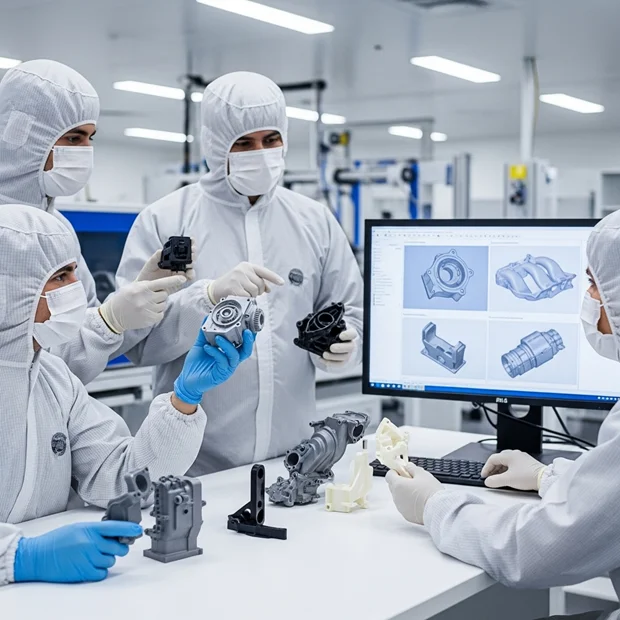
High-volume industrial production puts enormous pressure on manufacturers to deliver components that are precise, durable, and consistent batch after batch, with zero room for variation. Plastics have become the material of choice across sectors like aerospace, automotive, defense, electronics, and industrial systems, not because they are cheap, but because they are engineered to perform. When you combine the right material with the right process plastic design, plastic molding, plastic machining, plastic welding, and cleanroom assembly you get components that meet strict quality certifications, withstand harsh environments, and scale to meet demand without compromising tolerance or finish.
This article breaks down the core manufacturing processes that drive high-volume plastic production and explains how each stage contributes to better outcomes for mission-critical applications.
Why Plastic Design Is the Foundation of Every Successful Component
Most production problems originate long before a machine is switched on. They start at the design table. Plastic design done right means engineering for manufacturability from day one accounting for wall thickness, draft angles, material shrinkage, load-bearing requirements, and the specific tolerances demanded by the end application. CAD-based plastic design allows engineers to simulate real-world stress conditions, optimize geometries for strength-to-weight ratios, and catch interference issues before tooling is ever cut. In high-volume production, every design decision compounds. A part that is 2% heavier than necessary, or 0.1mm out of tolerance at the design stage, translates into significant cost overruns and rejected batches when scaled to tens of thousands of units. Industries like aerospace and defense are particularly unforgiving here a component for an aircraft fuselage or a military enclosure has no margin for guesswork. CAD-based plastic design and early-stage design for manufacturability (DFM) reviews are not optional steps; they are the starting point for any serious high-volume program.
Prototyping: Testing Before You Commit to Full Production Tooling
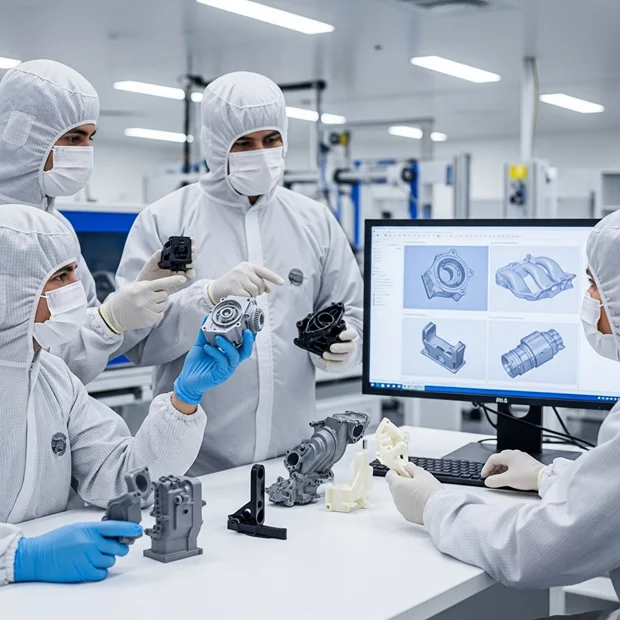
Plastic prototyping sits between design and production, and it is one of the most cost-effective investments a manufacturer can make. Building a functional prototype whether through 3D printing, rapid prototyping, or short-run molding allows engineering and quality teams to validate form, fit, and function before committing to expensive production tooling. For complex assemblies in automotive or electronics applications, a prototype run can reveal assembly challenges, mating surface issues, or structural weaknesses that would be far more expensive to correct after molds are cut. In regulated industries, prototyping also serves as the basis for regulatory submissions and pre-production approvals. The faster you can iterate at the prototype stage, the shorter your overall product development timeline and in competitive markets, that speed directly translates to commercial advantage.
Plastic Molding for Large-Scale, Precision Output
Plastic molding is the workhorse of high-volume plastic component production. Whether you are producing complex housings for electronics, lightweight structural parts for aerospace systems, or fluid-handling components for industrial equipment, the molding process determines the dimensional accuracy, surface quality, and structural integrity of every unit. Processes like injection molding, blow molding, and rotational molding each have specific strengths suited to different part geometries, wall thicknesses, and volume requirements. Injection molding dominates where tight tolerances and complex geometries are needed at high volumes. Blow molding handles hollow components tanks, containers, ductwork with excellent wall thickness distribution. Rotational molding serves large, complex hollow shapes where other processes would require multiple-part assemblies.
What separates good molding from great molding in an industrial context is quality systems integration. ISO-certified plastic molding, backed by real-time process monitoring and in-mold quality controls, ensures that every cavity produces a conforming part. For sectors like defense and aerospace, where mission-critical plastic components must meet strict aviation and military standards, this level of process control is non-negotiable.
Plastic Machining: Precision Where Molding Alone Cannot Reach
Not every feature of a complex plastic component can be formed during the molding cycle. Plastic machining including CNC machining, milling, turning, and drilling handles tight-tolerance secondary features that require a level of dimensional accuracy that molding simply cannot achieve on its own. Threaded inserts, precision bores, undercuts, and finished mating surfaces all benefit from post-mold machining operations. Tight-tolerance plastic machining is especially critical in industrial, automotive, and defense applications where assemblies involve multiple mating components that must align perfectly under load or thermal cycling. The choice of cutting tools, speeds, feeds, and coolant strategy matters significantly with engineering-grade plastics like PEEK, PTFE, nylon, polycarbonate, and UHMW materials that behave very differently from metals and require specialized machining expertise to avoid warping, melting, or stress cracking.
Plastic Welding: Creating Permanent, High-Strength Bonds Without Fasteners
Plastic welding is the process of joining thermoplastic components through heat, pressure, or vibration producing bonds that are as strong as the parent material, without adhesives, solvents, or mechanical fasteners. In high-volume industrial production, ultrasonic welding, hot plate welding, spin welding, and laser welding each offer specific advantages depending on the joint geometry, material, and production throughput required. Automotive manufacturers rely on plastic welding for fuel tanks, bumpers, and dashboard assemblies. Aerospace applications use welded plastic assemblies for cockpit components, ducts, and fluid systems. Defense and electronics manufacturers depend on cleanroom-compatible plastic welding to produce sealed enclosures that meet particle-free standards. The key benefit of welding over mechanical joining is the elimination of stress concentrations around fastener holes and the creation of a hermetic seal critical for fluid-handling, pressure-rated, and particle-sensitive applications.
Cleanroom Assembly: Where Contamination Control Meets High-Volume Production
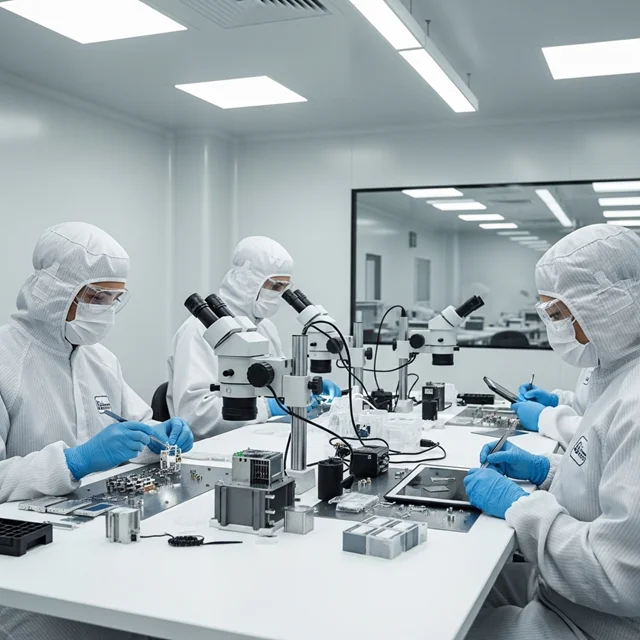
Cleanroom assembly and Class 7 cleanroom manufacturing represent the highest standard of controlled-environment production for plastic components. In aerospace, electronics, and defense applications, even microscopic particulate contamination can compromise component performance or cause field failures. A Class 7 cleanroom maintains no more than 352,000 particles per cubic meter of air, providing the controlled environment needed for sensitive assemblies like circuit board enclosures, optical housings, medical device components, and precision fluid systems. Cleanroom plastic manufacturing is not only about environmental control it also involves gowning protocols, material traceability, controlled incoming inspection, and documented assembly procedures that support regulatory compliance across ISO, AS9100, and ISO 13485 frameworks. Combining cleanroom assembly with in-house molding, machining, and welding under one quality management system dramatically reduces the risk of contamination events between production stages.
Why Foxx Technologies Stands Apart in Plastic Manufacturing
Foxxtechnologies brings over two decades of hands-on manufacturing expertise across the U.S. and Indian markets, operating five state-of-the-art facilities with six Class 7 cleanrooms and ISO 13485 certification. Their end-to-end capabilities spanning Plastic Design, Prototyping, Plastic Machining, Plastic Molding, Plastic Welding, and Cleanroom Assembly are delivered under a single integrated quality system, serving aerospace, industrial, automotive, defense, electronics, and retail sectors with precision-engineered components and proven scalability.
Integrating the Full Production Cycle for Maximum Efficiency
The highest-performing plastic manufacturing programs are those that integrate all stages design, prototyping, molding, machining, welding, and cleanroom assembly under one roof and one quality management system. When each of these processes is managed by separate vendors, handoffs introduce risk: tolerance stack-ups between suppliers, inconsistent material traceability, delayed root-cause analysis when quality issues arise, and longer lead times at every transition point. End-to-end plastic manufacturing under a single partner gives program managers visibility across the entire production chain. It means design engineers can communicate directly with the tooling and quality teams. It means a dimensional issue caught in machining can be traced back to the molding parameters within hours, not weeks. And it means annual maintenance contracts, new product development, and project consultation can all be handled by teams who already understand your application, your materials, and your compliance requirements making scale-up faster, more predictable, and less costly.
Frequently Asked Questions
Q1. What types of plastic manufacturing processes are best suited for high-volume industrial production?
Injection molding is the most widely used process for high-volume precision components. For hollow parts, blow molding and rotational molding are preferred. Secondary processes like CNC machining, ultrasonic welding, and cleanroom assembly are then integrated to meet tight tolerances and surface quality standards across aerospace, automotive, defense, and industrial applications.
Q2. How important is CAD-based plastic design before committing to production tooling?
Extremely important. CAD-based plastic design allows engineers to simulate load conditions, validate geometries, identify tolerance issues, and optimize wall thickness before any tooling is cut. Addressing design problems at this stage is significantly cheaper than correcting them after molds are produced, and it shortens the overall time to production launch.
Q3. What is a Class 7 cleanroom and which industries require cleanroom assembly for plastic components?
A Class 7 cleanroom limits airborne particles to 352,000 per cubic meter, providing a controlled environment that prevents contamination during assembly. Aerospace, defense, electronics, and medical device sectors routinely require cleanroom plastic assembly to ensure component purity, meet ISO 14644 standards, and comply with certifications like ISO 13485 and AS9100.
Q4. When should plastic welding be used instead of mechanical fasteners or adhesives?
Plastic welding is preferred when a hermetic seal, high joint strength, or particle-free bond is required. Unlike fasteners, welding eliminates stress concentrations around holes. Unlike adhesives, it creates a permanent thermoplastic bond without outgassing or cure time. It is the standard joining method for automotive fluid systems, aerospace ducts, defense enclosures, and sealed electronic housings.
Q5. What are the advantages of working with a single end-to-end plastic manufacturing partner versus multiple specialized vendors?
A single partner provides unified quality control, direct traceability from design to final assembly, faster root-cause resolution, and simpler project management. It eliminates inter-vendor tolerance stack-ups, reduces lead times at handoff points, and ensures that design, molding, machining, welding, and cleanroom assembly teams are all working to the same quality management system and compliance framework.